Trademark Assistance for Business Owners and Expanding Outlets
Separate The Legal Owner From Permission To Use The Brand
Trademark registration in Rawalpindi for shop, product and outlet brands. Review ownership, partnership records and filing instructions with Taxocrate.
Opening or expanding an outlet? Call to discuss brand ownership and schedule an appointment.
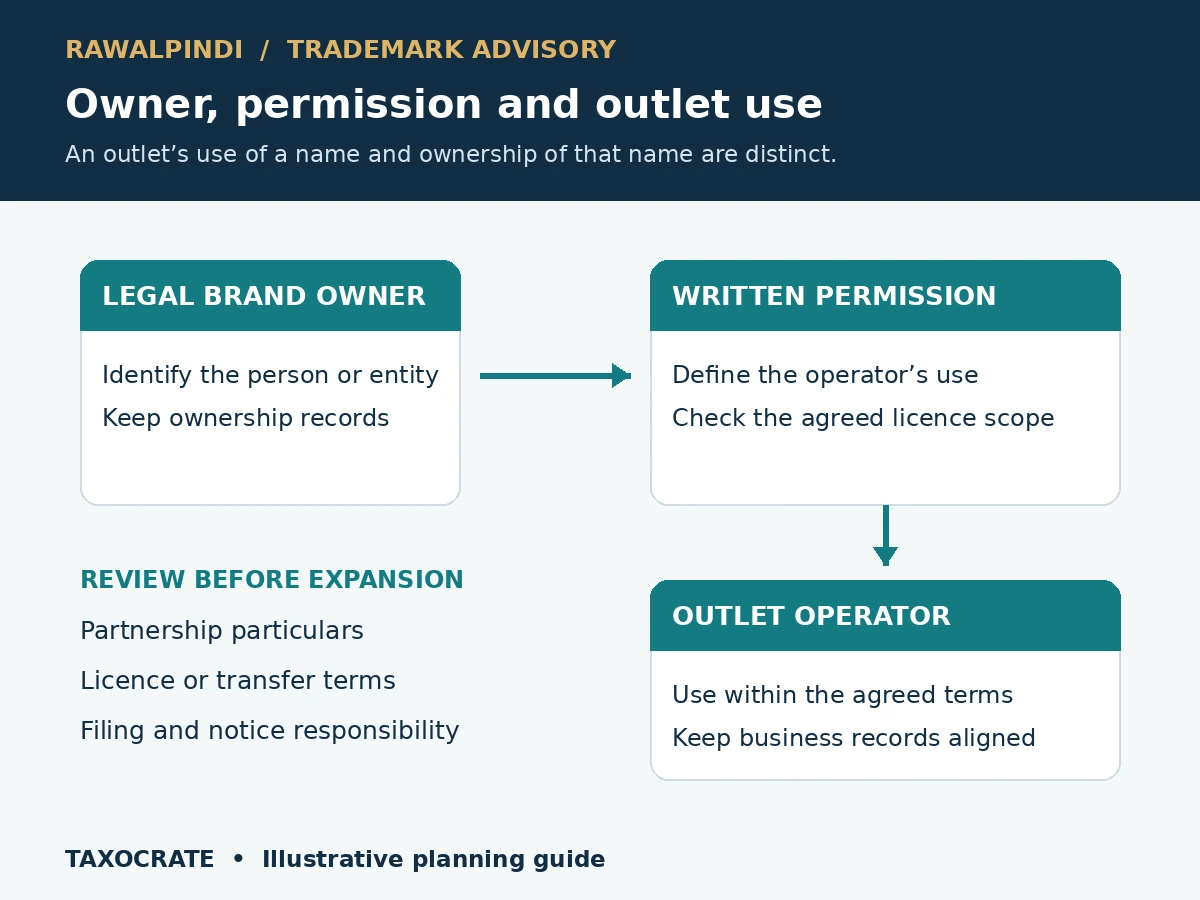
Illustrative outlet branding: distinguish the mark’s owner from an operator’s permission to use it.
Trademark Registration In Rawalpindi: Consultation
Rawalpindi Document Review and Service Enquiries
Speak with our professional team about Trademark Registration in Rawalpindi and schedule an appointment. Clients in Rawalpindi can enquire by phone before scheduling a visit. Office directions are shared via WhatsApp when your appointment is confirmed.
Professional Tax, Corporate and Regulatory Guidance With Senior Legal Review
Syed Mohsin Ali Shah
Senior Corporate And Taxation Lawyer
40+ Years Of Professional Legal, Tax And Corporate Experience
Syed Mohsin Ali Shah provides senior review for company structures, SECP filings, shareholder and director matters, corporate taxation, business documentation and higher-risk corporate issues across Pakistan.
10+ Years Of Professional Tax And Corporate Experience
Sobia Mohsin assists with company-registration documentation, corporate taxation consultation, post-incorporation compliance review and professional coordination for business clients across Pakistan.
Choose The Owner Before Expanding A Rawalpindi Brand
Trademark registration in Rawalpindi is particularly worth reviewing when a business brings in a partner, opens another outlet or allows another operator to use its name. Taxocrate assists with owner identification, searches, descriptions of goods and services and application coordination. Our legal team can consider the partnership or corporate records with the filing instructions so that the applicant’s name is supported by the intended business arrangement.
This service is also available for independent retailers, manufacturers and other product or service brands. The outlet examples on this page explain one practical set of ownership risks; they do not restrict protection to franchises. Describe your actual business and mark during the enquiry, even if it does not fit those examples.
A Trading Name Is Not Necessarily A Legal Person
A shop may display one name while its bank account, invoices and contracts identify an individual proprietor or partnership. Work out which person or entity is intended to hold the mark. Do not simply copy the signboard name into the applicant field without explaining the legal owner. If partners are involved, review their agreement and the basis on which the brand is held.
A business preparing to incorporate should also examine whether the mark will remain with a founder or be placed in the company. The existing documents and proposed arrangements matter. Forming a company does not silently transfer every earlier asset to it, and a change of structure should not be treated as a spelling correction to the applicant’s name.
Documents for Different Outlet Arrangements
Arrangement
Record to Review
One proprietor, one shop
The owner’s identity and how the trading name is used.
Partners using a common brand
Partnership terms and the agreed ownership of the brand asset.
Another operator using the name
The licence or operating agreement and limits on permitted use.
Sale or transfer of the brand
Transfer instrument, existing trademark details and required record updates.
The brand owner and the outlet operator may be different parties; document permission to use the name separately.
Ownership and Outlet Permission Need Separate Records
For example, a Rawalpindi restaurant owner may let a second operator open under the established name. The parties should distinguish the identity of the brand owner from the operator’s permission to use it. The operating agreement can address the approved name or logo, permitted business activity, territory or outlet and arrangements when the relationship ends. The trademark filing is a separate part of that wider documentation.
Do not allow the franchise or distribution vocabulary to hide uncertainty about rights. A licence, commercial partnership and assignment are not identical arrangements. Review what the parties actually agreed and what evidence exists. Where the proposal involves transfer of a registered mark, the relevant Registry steps also need attention; a private payment receipt alone should not be treated as the complete record.
A Filing Checklist for A Partnership Or Growing Business
Collect the proposed mark, legal owner particulars and a description of the goods or services offered under it. Add the partnership deed, company particulars or relevant licence only where they are needed to establish the filing position. If one partner previously applied, provide that application reference. An existing registration, ownership change or dispute should be raised before another application is instructed.
For a business with several outlets, note which activities each operator carries on and how the brand is presented. Keep sample signage, menus, labels or advertising dated and attributable to the right business. These records can help explain the review; their existence does not automatically prove registrability or resolve a contested ownership claim.
Search The Name Before Committing To New Signage
An outlet expansion can involve substantial expenditure on fit-out, uniforms and publicity. Review the proposed word mark and logo before treating the launch materials as final. A search should be connected to the actual business activity, not limited to whether somebody has registered the same social-media username. Similarity concerns require an assessment of the relevant marks and context.
The outcome of a preliminary search informs planning, but it is not a guarantee of registration. If the applicant decides to proceed, agree the class applications, official payments, professional work and follow-up responsibilities. An objection, opposition or ownership dispute may call for additional work beyond preparing and submitting the application.
Keep The Business and Application Records Aligned
After submission, preserve the acknowledgement and monitor correspondence through the nominated contact. Inform the adviser if partners change, the business is sold or the intended owner changes. Do not assume that moving an outlet or altering the signboard updates the Registry record automatically. Review the existing application or registration before making representations about the mark’s status.
Use the dedicated Rawalpindi contact actions to arrange an enquiry or appointment. Confirm the service location before travelling. Our National Trademark Service Page explains the broader framework. If the business structure is also being reconsidered, Company Registration in Rawalpindi is a related service, not a replacement for trademark work.
Can A Partnership Apply Under Its Shop Name Alone?
Explain the legal partnership and the people behind the trading name before preparing the applicant particulars. A signboard does not establish a separate legal person. The deed and relevant business records can help clarify who is intended to hold the mark. Do not choose one partner arbitrarily simply because that person handles the correspondence.
May An Outlet Operator Register The Franchisor’s Name?
Review the agreement and any express authority first. Permission to operate under a name is different from entitlement to claim ownership of it. The operator’s own mark may be a separate asset, but the franchisor’s brand should not be treated as belonging to the operator merely because the outlet pays fees or receives sales income.
Does Adding A Partner Automatically Change The Trademark Owner?
No automatic change should be assumed. Examine how the asset is currently held and what the new arrangement provides. Existing application or registration details should be reviewed alongside the partnership documents. Tell the adviser about the proposed change before submitting conflicting instructions or describing the new partners as registered owners.
What If One Family Member Filed for A Shared Business Brand?
Obtain the application details and examine the family business arrangement, relevant agreements and intended ownership. The applicant named in the filing and the people operating the business may not be the same. Avoid a second filing as an automatic solution; the appropriate response depends on the records and whether ownership is disputed.
Is A Licence The Same As Selling The Trademark?
A licence generally concerns permission to use the mark under agreed terms; a sale or assignment concerns a transfer of rights. Review the actual instrument rather than its informal label. A registered-mark transfer may also require Registry record steps. Specify what is being granted or transferred before payment or filing instructions are finalised.
Can We Use The Same Brand for A Restaurant and Packaged Goods?
Describe the restaurant service and the packaged products separately. The mark’s use across different activities needs classification and filing review. Do not assume that an outlet-related application covers all products later sold under the name. Ask for a clear explanation of the proposed applications and their scope.
Should We Search Before Opening A Second Rawalpindi Outlet?
A review before investing in new signage and launch materials is sensible, particularly if the earlier ownership or filing position is unclear. Provide the existing mark details and explain the planned expansion. A search can inform the decision, but it cannot promise that no objection or commercial dispute will arise.
What Information Starts A Rawalpindi Service Enquiry?
Describe the name or logo, the legal business owner and whether you need a first application, follow-up, ownership review or assistance with an existing notice. You can arrange the conversation before sending documents. The team can then identify the relevant records and confirm the appointment location.